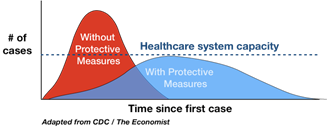
Current Prevalence of #COVID19 in BC: As of March 12, 2020:
The BC Centre for Disease Control (BCCDC) reports that as of March 6th, 2020:
- 2,008 individuals and 2,803 samples were tested for COVID-19
Note: This vastly under counts the actual numbers of people in BC who have COVID-19. Thousands of people who have had COVID-19 exposures have come to Canada since the outbreak started overseas, and began spreading from country to country. More information below about why these numbers under-represent the true prevalence rates in BC.
117 confirmed cases in Canada: BC:46 (up 7 today); ON: 42; AB: 19; QC: 9; NB: 1
Note: Reproduction rate (R0) of COVID-19: Every 1 person with a confirmed case may/can spread the virus to 2-4 people. (2.2-3.58). Link here.
- Research based on China. Other countries may have different statistics about virulence, or the rate of transmission.
- Research based on China. Other countries may have different statistics about virulence, or the rate of transmission.
Super-spreaders: People who can transmit the virus to more people than the average R0.
#COVID19 (#Coronavirus)
Updates: BC, Canada, and Global Data Tracker
Link: https://www.covid-19canada.com/
Fact #1: The BC Government and the BC Centre
for Disease Control (BCCDC) have limited the exposure criteria for testing for COVID-19 in
BC to the following:
“Who to test: Testing is available for
patients with compatible symptoms (e.g. fever, cough, or difficulty breathing)
AND history of travel to affected areas including China
(mainland), Hong Kong, Iran, Italy, Japan, Singapore, and South Korea two weeks
prior to illness onset or other index of suspicion (e.g,. contact with an ill
person with such travel history).”
Source:
The BCCDC webpage for Clinical Resources and
Guidelines from Health Care Professionals. Retrieved from: http://www.bccdc.ca/health-professionals/clinical-resources/novel-coronavirus-(covid-19).
The BCCDC page also states the following:
Testing and laboratory guidance: Testing requires
notification and consultation with the local Medical Health Officer and the
BCCDC PHL Medical Microbiologist on-call (604-661-7033).
Comment: The BC government and BCCDC have NOT
been following PHAC’s exposure and testing criteria from the beginning of the
COVID-19 outbreak. PHAC's criteria includes discretion about who can get tested. BC has created
their own criteria that is not consistent with the Canadian government’s criteria, or
international public health best practices for infectious disease management.
Since the beginning of the COVID-19 outbreak in
China, and once symptomatic people in BC and Canada started seeking medical
attention and testing, the BC government has limited exposure and testing
criteria. This testing limitation continues.
Testing guidelines below demonstrate
that not all individuals in BC who are part of an epidemiological cluster who
become symptomatic for COVID-19 will be tested and confirmed to have the virus.
This is leading to inaccurate/false reporting about the real number of cases in
BC.
Vulnerable, high-risk populations are not being tested: It is also likely the case that individuals in higher-risk categories, such as seniors who experience flu symptoms,
may not have been tested for COVID-19, pre- or post-death. This will lead to
decreased confirmed cases for COVID-19 and confounds and under-represents that
true epidemiological statistical data, and picture of COVID-19 in BC and
Canada.
Provincial Health Services Authority (PHSA): PHSA
Laboratories: COVID-19 Guidance on Sample Collection and Testing as of Feb 27,
2020
PHSA
Note: Please ensure that you are using the latest guidance
document, available at http://www.bccdc.ca/health-professionals/clinical-resources/coronavirus-(novel)
1)
Who to test and why?
a)
Patients with respiratory illness in relation to recent
travel from an affected area or, contact with a person known or suspected to be
COVID-19 infected. (Samples will
be tested for FLUA/B/RSV and COVID-19).
b)
We are recommending COVID-19 testing for the same
patients that you would normally test for FLUA/B/RSV. (Samples will be
tested for FLUA/B/RSV and COVID-19).
c)
Patients who are part of a respiratory outbreak
cluster (i.e., within a household or facility). It
is not necessary to test all cluster members. Testing a maximum of six members from a cluster will
identify the cause of most outbreaks. (Samples will be tested for FLUA/B/RSV
and COVID-19).
Source: PHSA
Laboratories. Retrieved from: http://www.bccdc.ca/resource-gallery/Documents/Statistics%20and%20Research/Statistics%20and%20Reports/Epid/Influenza%20and%20Respiratory/ERV/BCCDC_PHL_Updated_nCoV_Lab_Guidance.pdf.
Fact #2: Why People are Not Getting Tested for COVID-19 in their Health Regions
Why have Doctors in BC in Community Health and
Hospitals been Limiting/Refusing Testing for COVID-19?
Health authorities in BC provide physicians
operating in their health regions with clinical guidelines, direction, and
updates via physician updates about how they are expected/directed to manage
patients presenting with symptoms of COVID-19.
Vancouver Coastal Health Physicians Update (February 26,
2020):
These
guidelines have not been updated to take community transmission into consideration, and direct doctors in VCH to use the following guidelines:
The
Public Health Agency of Canada recommends COVID-19 testing for:
- Patients with compatible symptoms (e.g. fever, cough or difficulty breathing) AND
- Travel within 14 days of symptom onset to an affected area including: OR
- Close contact with a confirmed or probable case of COVID-19
Fraser Health Authority: Medical Health Officer Updates
Updated guidance for suspect cases of novel coronavirus (COVID-19) - March 4, 2020
Consider testing for novel coronavirus for:
- Patients with compatible symptoms (e.g., fever, cough, or difficulty breathing) AND
- History of travel to an affected area (as of Mar. 4, 2020, affected areas include: China, Hong Kong, Iran, Japan, Italy, Singapore, and South Korea) within 14 days prior to illness onset OR other index of suspicion (e.g., contact with an ill person with travel to affected areas, contact with a confirmed or probable case of COVID-19).
- We do not recommend COVID-19 testing in asymptomatic patients. We have developed a patient-facing document that provides information to asymptomatic patients requesting testing, which is available here.
Fact #3: Who Isn’t getting Tested for COVID-19 in
BC and Canada
The exposure and testing criteria is so narrow that the vast majority of people who are now becoming infected with COVID-19 in BC are unable to get tested.
Around BC and Canada people who are symptomatic who present to
health care providers are being refused testing for COVID-19, because they do not meet the exposure criteria that BC (and other regions of
Canada) continues to use. These include:
- Health care workers: doctors, nurses, care aides, all others, including admin staff
- First responders: police, fire fighters, paramedics,
- Frontline helping professionals: Community/Mental health/addictions workers; social workers; therapists; housing workers, all others.
- Airline flight crew; people working in airports.
- Transportation staff: bus drivers; skytrain attendants; ferry workers.
- Politicians and staff: Elected officials and others.
- Customer service and retail workers.
Fact #4: Community Transmission in BC and Canada
As of
March 9th, 2020 the BC government and BCCDC officials have confirmed that community transmission is now occurring for COVID-19. It
has been scaling up, with thousands of Canadians exposed to individuals who are
just getting diagnosed, or those who have been refused testing in their communities.
Several health care workers in BC, in different health authorities (Vancouver
Coastal and Fraser Health) working in community care have been confirmed with COVID-19. These individuals do not fit the within the narrow exposure criteria
for testing still being used in BC.
Individuals/patients who became exposed and
infected through these health care exposures, including patients who have been confirmed to have COVID-19, do not
fit the ongoing limited and narrow exposure and testing criteria in BC or
Canada.
BC and Canada’s ongoing testing criteria
limitations (and test suppression in the community) also excludes family
members of the affected health care
workers, work colleagues, or others who they may have unintentionally exposed
at home, work, or in their communities.
This means that if any of these individuals become symptomatic, they
will not meet the testing criteria BC continues to refuse to update, or change, to increase the numbers of individuals who are being tested, diagnosed,
identified, and for monitoring and contact tracing to occur to warn others of
their exposures. All of these are best practices in public health management
and responses to viral outbreaks.
Fact #5: How Does One Get Tested for COVID-19 in BC?
Individuals who call 8-1-1 and speak with
nurses are directed to go to family doctors/walk-in clinics in BC/Canada for
assessment if their cases seem to warrant this.
Individuals who present at many family
doctors/walk-in clinics in BC/Canada are being told they do not have the
capacity to test for COVID-19. Symptomatic patients are being told by community health care providers to go to local
hospitals for testing.
Upon presenting at local hospitals symptomatic people are
being refused testing for COVID-19 if they do not fit the current narrow
exposure criteria the BC government/BCCDC and local health authorities are
still using.
Fact #6: Epidemiological Outcome of Test Suppression in BC
Thousands of people with exposure histories,
both overseas, and locally through community transmission (including the
families/contacts of exposed health care workers) have been being refused testing
for COVID-19 in BC, and other areas of Canada.
Two secondary outcomes of test suppression in BC
and Canada are:
People who are asymptomatic/pre-symptomatic are
contributing to community transmission and spread, and scale up of COVID-19 because they have no symptoms
at all, or they have milder cases and may not associate their symptoms with this virus.
Many people with undiagnosed/untested cases of COVID-19 are not being identified, being monitored, having contact tracing done (investigating who they may have infected through contact), and they are being included in the real prevalence statistics which decreases the validity of B.C.'s reports on the true numbers of people who have COVID-19.
People are undiagnosed/untested are unaware of the risks of spreading the virus to others, and may not be using strategies, such as social distancing, to limit and contain the spread, and are contributing to the scaling up of community transmission of COVID-19.
Fact #7: BC Health Care Workers Exposed At Work
The BC government and the BCCDC have confirmed that some of the newest confirmed cases, as of March 10th, 2020, have been health care workers.
They have also reported that at least one of these HCW's was the index patient who exposed and transmitted the virus to others. This fits the definition of community transmission.
None of these individuals fit within the narrow exposure criteria that the BC government and the BCCDC continue to use. This is significantly limiting the numbers of people who work in health care who can get tested for COVID-19 in BC. That is impacting the prevalence rates to identify the true numbers of of people who have it.
The BC government and BCCDC and many elected officials, government and health authority officials continue to report we are "low risk" in BC. That is not an accurate statement. Some of us face much higher risks, and that includes health care workers, and their families, and contacts.
Please remember: NO ONE expects to be exposed to, or contract an infectious disease at work. All of the research and inquiries after previous epidemics, such as SARS, demonstrated that health care workers were put AT RISK on the job, with little support, inadequate personal protective equipment (PPE) provided by employers, and a lack of advocacy on the part of their professional organizations and/or unions. That is also happening for health care workers around BC and Canada with COVID-19.
Fact#8: What Can You Do About This Situation
Speak to your Family Doctor: Insist on being tested for COVID-19 and other influenzas. If your doctor refuses to test you, or reports they don't have testing kits, ask them to chart that they have refused you testing for the reasons they give you.
The College of Physicians and Surgeons of BC outlines Access to Medical Care for patients, advising the following of it's registrants:
The Canadian Medical Association (CMA) Code of Ethics and Professionalism is founded on the
fundamental principles and values of medical ethics: compassion, beneficence, non-maleficence, respect
for persons, justice and accountability. Appropriate access to medical care is a core value of Canadian
society, and this access should be equally available to all patients, including those in vulnerable and
marginalized populations.
Contact your MLA and MP
Email, or contact your MLA to tell them you want them to advocate for the exposure
criteria to be changed, and updated in BC and that more testing for COVID-19
can occur in BC, or Canada.
Report local testing refusals by doctors to MLA’s: Advise them if you, anyone in your family, or in your
community has been refused testing for COVID-19. BC’s elected officials have
been completely silent while community transmission is spreading, including in
their own ridings.
Find out your MLA’s
contact information here:
MLA’s
by name: https://www.leg.bc.ca/learn-about-us/members
Search
for your MLA by Postal Code: https://www.leg.bc.ca/Pages/BCLASS-Member-Search-PostalCode.aspx
Contact your MP (Member of Parliament):
Email, or contact your MP (Member of Parliament): Tell them you want them to advocate for the exposure criteria
to be changed and updated in BC and that more testing for COVID-19 can occur in
Canada.
Report local test refusals to MP’s and senators: Advise them if you, anyone in your family, or in your
community has been refused testing for COVID-19. BC’s elected officials have
been completely silent while community transmission is spreading, including in
their own ridings.
Find out your MP’s contact
information here: https://www.ourcommons.ca/Members/en
Advocate for your Professional Organization, Union and Employers to Do More to Protect You and Others at work.
Contact WorkSafeBC to inspect Unsafe Workplace conditions:
Link: https://www.worksafebc.com/en/health-safety/create-manage/rights-responsibilities/refusing-unsafe-work
File a Claim if you are infected/injured at work: https://www.worksafebc.com/en/claims/report-workplace-injury-illness
References
BC Centre for Disease Control. Novel coronavirus (COVID-19). Retrieved from: http://www.bccdc.ca/health-professionals/clinical-resources/novel-coronavirus-(covid-19).
BC Government. (2020). Pandemic Preparedness: COVID-19 Preparedness and Planning Materials. Retrieved from: https://www2.gov.bc.ca/gov/content/health/about-bc-s-health-care-system/office-of-the-provincial-health-officer/current-health-topics/pandemic-influenza.
BC Government. (2020). Pandemic Provincial Coordination Plan. Retrieved from: https://www2.gov.bc.ca/assets/gov/health/about-bc-s-health-care-system/office-of-the-provincial-health-officer/reports-publications/covid-19-technical-briefing.pdf.
Canadian Press. (2020). Nurses' unions warn national standards for coronavirus protection too low. Retrieved from: https://ca.news.yahoo.com/nurses-unions-warn-federal-standards-12000457.
Smith, M. (2020). Coronavirus is already taking a toll on Canada's front-line health-care workers. Macleans. Retrieved from: https://www.macleans.ca/society/health/coronavirus-is-already-taking-a-toll-on-canadas-front-line-health-care-workers/.
Contact WorkSafeBC to inspect Unsafe Workplace conditions:
Link: https://www.worksafebc.com/en/health-safety/create-manage/rights-responsibilities/refusing-unsafe-work
File a Claim if you are infected/injured at work: https://www.worksafebc.com/en/claims/report-workplace-injury-illness
References
BC Centre for Disease Control. Novel coronavirus (COVID-19). Retrieved from: http://www.bccdc.ca/health-professionals/clinical-resources/novel-coronavirus-(covid-19).
BC Government. (2020). Pandemic Preparedness: COVID-19 Preparedness and Planning Materials. Retrieved from: https://www2.gov.bc.ca/gov/content/health/about-bc-s-health-care-system/office-of-the-provincial-health-officer/current-health-topics/pandemic-influenza.
BC Government. (2020). Pandemic Provincial Coordination Plan. Retrieved from: https://www2.gov.bc.ca/assets/gov/health/about-bc-s-health-care-system/office-of-the-provincial-health-officer/reports-publications/covid-19-technical-briefing.pdf.
Canadian Press. (2020). Nurses' unions warn national standards for coronavirus protection too low. Retrieved from: https://ca.news.yahoo.com/nurses-unions-warn-federal-standards-12000457.
Smith, M. (2020). Coronavirus is already taking a toll on Canada's front-line health-care workers. Macleans. Retrieved from: https://www.macleans.ca/society/health/coronavirus-is-already-taking-a-toll-on-canadas-front-line-health-care-workers/.


